Leicester General Hospital: which site, which services and where to check care ratings?
Leicester General Hospital is on Gwendolen Road, Leicester. Learn how to reach the right department, understand emergency routes, and check CQC ratings for specific services—not just the hospital overall.
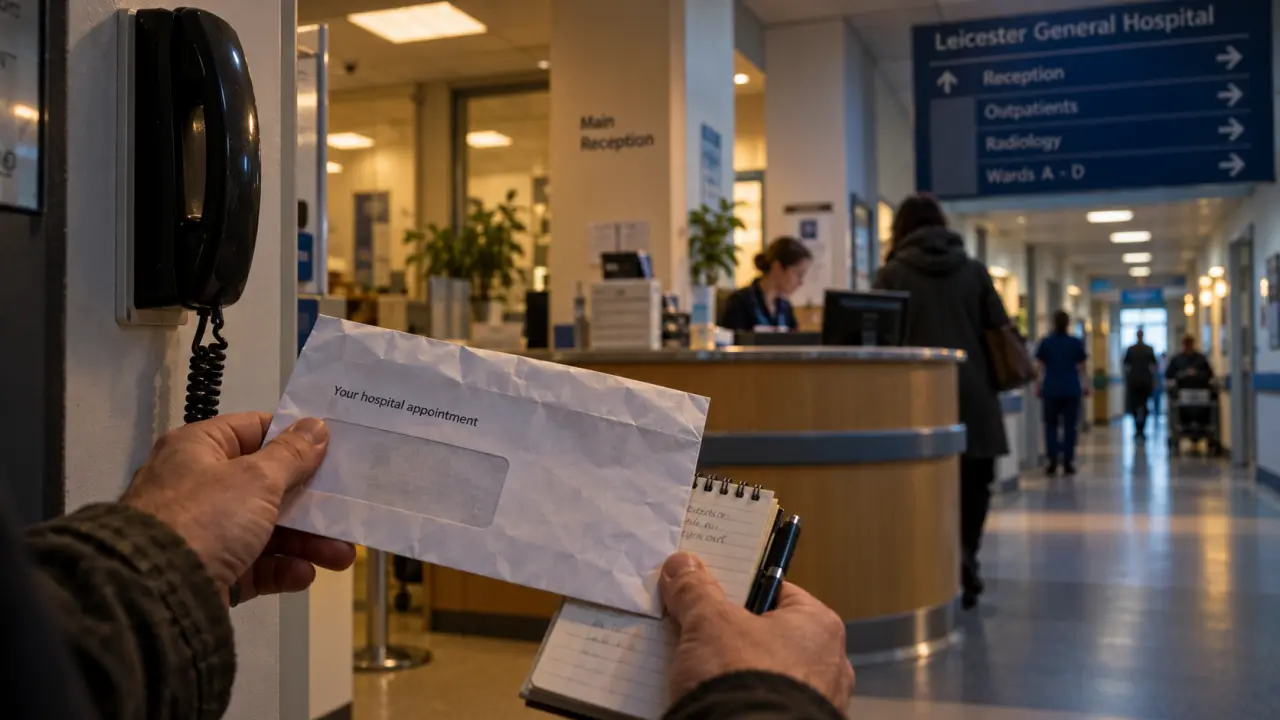
Leicester General Hospital is on Gwendolen Road, Leicester, LE5 4PW. Its switchboard number is 0300 303 1573, available 24 hours a day, according to the official hospital page. For patients arranging a visit, the key distinction is between finding the hospital and confirming the particular department they need.
Leicester General Hospital, Leicester: address and contact details
The NHS hospital listing gives the address as Gwendolen Road, Leicester, Leicestershire, LE5 4PW. The hospital is operated by University Hospitals of Leicester NHS Trust, as recorded by the Care Quality Commission.
| Detail | Information |
|---|---|
| Address | Gwendolen Road, Leicester, Leicestershire, LE5 4PW |
| Switchboard | 0300 303 1573 |
| Switchboard availability | 24 hours |
| Responsible organisation | University Hospitals of Leicester NHS Trust |
A 24-hour switchboard does not mean every department operates a walk-in service around the clock. When calling, have the department name or appointment letter to hand. Ask for the relevant team rather than relying on a broad description such as “the clinic”.
Before travelling, check the hospital name, department and entrance on your appointment correspondence. Confirm parking, visiting arrangements and any access assistance with the hospital rather than relying on older directions. The postcode identifies the destination, but your appointment details should determine where you report.
Emergency care and specialist services are different routes
Leicester General Hospital is listed without an Accident & Emergency department in its hospital profile. Do not assume that the word “General” means it is the appropriate destination for an unplanned emergency visit. The official hospital page directs people with urgent, non-life-threatening medical problems towards NHS 111 for guidance.
The CQC registration covers service categories including maternity and midwifery, family planning, termination of pregnancy, surgical procedures, diagnostic and screening procedures, and treatment of disease, disorder or injury. These are regulatory categories, not a department-by-department appointment directory.
The hospital’s historical account also describes associations with renal care, urology, orthopaedics, diabetes research, brain-injury treatment and treatment for disabled children. Those associations should not be treated as confirmation that every service remains available at the same location or through the same referral route.
Think of hospital information as layers: the institution’s identity forms the foundation, service registration sits above it, and your individual appointment is the top layer. A hospital can retain its name while a clinic’s location or access route changes. Checking all three layers helps avoid a common mistake: reaching the right hospital organisation but the wrong site or department.
CQC ratings: check the service as well as the hospital
The Care Quality Commission’s Leicester General Hospital record is the appropriate place to check published inspection findings and ratings. It separates the hospital assessment from ratings for particular services. A hospital-wide judgement should not be read as an identical verdict on every ward, clinic or treatment pathway.
When reviewing the record, distinguish between three things:
- The overall assessment: the broader judgement about the hospital.
- The service assessment: findings about the area relevant to your care, such as surgery or outpatients.
- The assessment date: when that particular service was inspected, rather than simply when a report page was published.
The record includes different inspection dates: 26 January 2017 for medical care, critical care and end-of-life care; 14 March 2018 for diagnostic imaging; and 5 February 2020 for outpatients and surgery. These dates matter because the assessments are not a single simultaneous snapshot. Read the relevant report alongside its rating, particularly where it identifies improvements required or differences between services.
From North Evington infirmary to the wider Leicester hospital network
According to the hospital’s historical account, construction began on 2 April 1903, and the institution opened as North Evington Poor Law Infirmary on 28 September 1905 with 512 beds. It became City General Hospital in 1930 and Leicester General Hospital in 1948, following the creation of the NHS.
The same account records teaching-hospital status in 1975 and the first kidney transplant on 12 March that year. In 2000, Leicester General joined Glenfield Hospital and Leicester Royal Infirmary in the merger that formed University Hospitals of Leicester NHS Trust.
Wikipedia cites approximately 430 beds, but that reference figure should not be used as a live measure of capacity or availability. For patients, the practical consequence of the wider hospital network is simpler: check the named hospital on each appointment. A familiar trust name does not, by itself, identify the building where your care will take place.